Most Utah buyers ask, “Is this sewer line bad?”
The better question is: “What pipe material is this, and what failure pattern should we expect?”
In Salt Lake County and Utah County, material type often tells you more than age alone. This guide breaks down the four materials we see most and what they usually mean for risk, timeline, and negotiation.
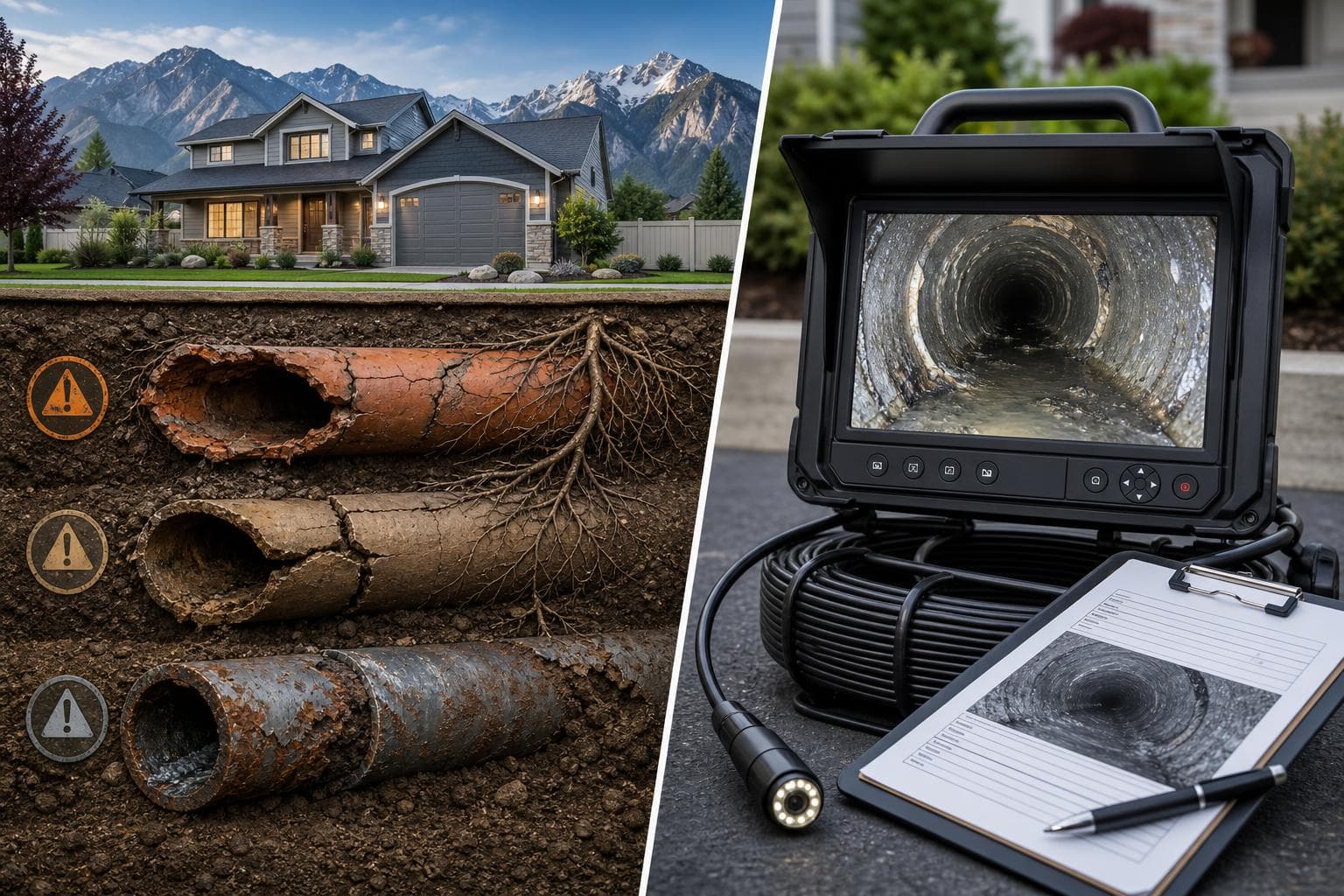
Utah sewer pipe types: quick risk snapshot
| Pipe type | Common era | Typical risk pattern | Buyer risk level |
|---|---|---|---|
| Orangeburg | ~1945–1972 homes | Deformation, soft walls, collapse risk | High |
| Clay (vitrified) | Many older neighborhoods | Root intrusion at joints, offsets, cracks | Medium–High |
| Cast iron | Common in older homes | Internal corrosion, scaling, occasional cracks | Medium–High |
| ABS/PVC | Newer installs | Lower material risk, but install/slope defects still possible | Low–Medium |
1) Orangeburg sewer pipe in Utah: highest caution category
Orangeburg is a bituminous fiber pipe used heavily in mid-century construction. In practical terms: once it ages out, it can oval, soften, and fail fast.
What we commonly watch for on camera:
- out-of-round sections,
- wall deformation,
- repeated backups even after cleaning,
- segments where replacement is more realistic than patching.
If Orangeburg is confirmed and defects are active, buyers usually negotiate from a replacement planning posture, not a “quick clean-out solves it” posture.
2) Clay sewer line risk: durable material, vulnerable joints
Clay itself can last a long time. The weak points are usually the joints and alignment over decades of movement.
Common findings:
- root intrusion at joints,
- offsets between pipe sections,
- cracks/chips,
- low spots that hold waste.
Clay is often manageable when defects are minor, but repeat intrusions and larger offsets can become recurring maintenance or repair costs.
3) Cast iron sewer line risk: corrosion is the main story
Cast iron lines often fail from the inside out. Scale buildup narrows flow, catches debris, and can hide deeper deterioration.
Common findings:
- heavy internal scaling,
- corrosion roughness,
- channeling at the invert,
- occasional cracks or separations.
Not every cast iron line is a crisis. But advanced corrosion usually means the buyer should budget for near-term repair strategy, not just emergency response.
4) ABS/PVC: lower material risk, still not “risk-free”
Newer plastic lines usually perform better, but material alone doesn’t guarantee a clean line.
We still see:
- improper slope,
- settlement-related offsets,
- construction debris,
- poor tie-ins.
That’s why newer homes still benefit from a camera scope during due diligence.
Sewer scope in Utah County and Salt Lake County: how material changes negotiation
Material type helps decide whether you ask for:
- Cleaning/maintenance (minor roots, light buildup)
- Credit for planned repair (moderate recurring defects)
- Major concession / replacement planning (deformation, collapse indicators, severe offsets)
If you want a deeper playbook on credits vs repairs, use our Utah sewer scope negotiation guide.
What to ask your inspector (fast checklist)
- What exact material is confirmed on video?
- Is the defect functional (active blockage/flow loss) or early-stage?
- Are problem points located/marked clearly for contractor bidding?
- Is this likely maintenance, spot repair, or replacement planning?
- What should be done before close vs after close?
If you need help interpreting terms like roots, offsets, bellies, and cracks, read How to Read a Sewer Scope Report.
FAQ: Utah sewer pipe types
Which sewer pipe type is highest risk for Utah homebuyers?
Usually Orangeburg, because aging sections can deform and fail quickly.
Are clay sewer lines always bad?
No. Clay can perform for a long time, but joint movement and root intrusion are common defect patterns.
Should I skip a sewer scope on newer homes?
No. Even ABS/PVC lines can have install or slope defects that matter during due diligence.
Bottom line
For Utah buyers, pipe material + defect severity + location evidence is what drives smart decisions.
The goal isn’t to panic. It’s to classify risk correctly while you still have leverage in due diligence.
Want a clean, independent read before closing? Book your sewer scope, or start with our FAQ.